Monday, February 10, 2014

The Golden Cape


Twenty years ago today I wrote my first book. Oh sure, there was the book they helped us make in Kindergarten (a cat climbing a tree to eat apples?), but this time was independent of any teacher or grownup saying, “Hey, you should do this.” This time I decided on my own that I could be an author. So I was. I stapled together some of the old green-and-white-striped computer paper we used for coloring and I wrote down the story of The Golden Cape, based on a dream I’d had. At a whopping 222 words, it was quite the fantasy epic. Below you’ll see a scanned picture of the cover. 


And the title page...
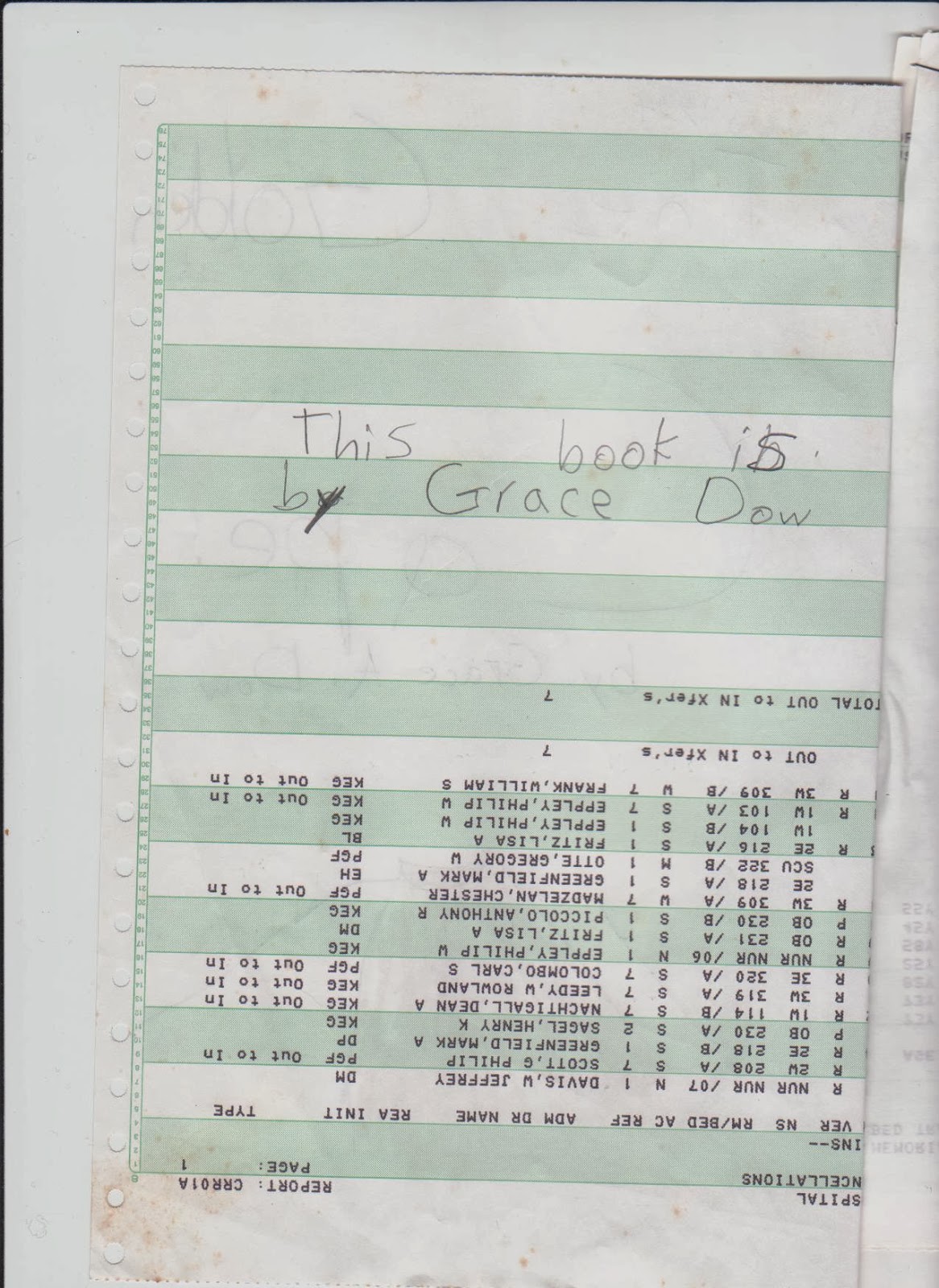

And here's the story itself (I'll transcribe without misspellings below, in case you can't read 7-year-old Grace's writing)...


"Once there lived two kings who were neighbors. One of the kings had a golden cape. His name was Leontes. The other king's name was David. David asked Leontes if he could borrow his golden cape."


"Leontes said yes. While David borrowed the cape it tore to bits. Time passed. A girl and a boy came to a store where an ogre sat in front. They asked him where they could get money. He sent them off to place where there was no money. But instead the bits of the golden cape were there."

"The girl sewed them together and all of a sudden they were walking through a forest. They were only three inches long but they did not notice. Then they walked into a hollow log and there was a queen, a fairy queen and her friends.  But there also lived at the other side of the forest an evil wizard. The queen gave them instructions to go to the wizard's castle and bring back the gold plate and they would get a reward. They did as she told them and brought the gold plate."


"Then in a flash of light they were back with the Golden Cape. They brought the cape home and sold it for a lot of money, and everyone lived happily ever after. The End."


Well, two decades later, and I’m still writing. Not as much as I’d like, or as often, but it’s kind of like breathing - you make the time for it, because without it you’d surely die. To celebrate this fact, that twenty years down the road I’m still doing this crazy thing, I decided to revisit that old story. This was a spur-of-the-moment decision, so much like my 7-year-old self, what you're getting here is a first draft. I'll put it below if you’re interested, a slightly fuller version of the tale, featuring rich fools, poor orphans, an ogre, a fairy queen, a powerful magician, and of course that eponymous golden cape.

Here’s to adventure, and to stories - and here’s a huge, whole-hearted thanks to all of you who’ve shared both these things with me along the way. So without further ado...


Part One: The Rich Men

In a time of kings and paupers there lived two rich men, who often squabbled over things of little importance. One man would throw a grand party, and his neighbor would follow suit with one even more lavish and grandiose. One of the pair would buy a huge statue for his front yard, and the other would in turn install a fountain so gaudy and enormous that people from all around would travel out just to behold the spectacle. But one day one of the men played host to a renowned and powerful sorcerer, and this magician repaid the kindness with a gift. Here was a thing of such glorious wonder that it could surely never be duplicated or eclipsed…
It was a cape, made entirely of gold spun to thread. It shimmered even in shadow. It flashed bright and blinding in the sun. To wear it was to resemble a fearsome and flawless being of heaven. It was truly a thing beyond compare.
So of course the man did as we might come to expect he would. He wrapped the cape around himself and paid a visit to his neighbor. Oh, the neighbor said all the proper and cordial things, but all the while he trembled with jealousy and rage. When the man at last swept out of his home with that golden cape trailing fire and starlight behind him, the neighbor sat alone for a long while and despaired, for he knew he had been well and truly beaten and the unfairness of it clenched his guts and throbbed in his temples and made him bite the inside of his cheek until it bled.
How could he ever surpass such a matchless marvel? What could he do to wipe that smug smile off his enemy’s face?
In the night he crept over to steal the golden cape. But he knew just looking at it that having it would never be enough. His neighbor would surely accuse him, might even insist upon a search. He would be found out. The golden cape would be discovered and returned. No, what he needed more than anything was for the golden cape to never even have existed, to put them on equal footing once more. So he grabbed the soft shimmering folds of the cloak up in his hands and pulled and ripped and tore until all that was left of the beautiful cape was tatters and scraps and shreds.
It felt good, this act of destruction. It felt powerful and right. But as soon as he had done it, he knew that he must never be found out. So he took the remains of the cape and traveled down into the city far below. Here in a random passage between two buildings he spied a garbage can. He lifted the lid and flung the golden rags into its depths. Then he ran away from the city, turning his back on this thing he had done, returning once more to the heights and to victory.

Part Two: The Children

They had ogres guarding the doorways now to keep the riffraff out. Actual ogres—seven feet tall, with blocky heads and arms and legs like logs, and huge yellow teeth with a green like moss growing out between them. That’s not to say that all ogres are mean just because they look so ferocious, but this one was. He threw—literally threw—the children back out into the street, and sputtered and growled that if they ever came back he’d simply eat them next time instead.
The two children, an orphaned brother and sister, had been looking for a quiet corner to spend the night out of the cold. This was a bitter winter, and the town’s citizens had tired quickly of beggars, so the children received little any more in the way of coins or sympathy. Now it seemed even the inns and restaurants were keeping careful watch to turn them away. They were hungry and the night was harsh, and they had nowhere to go.
The girl picked herself up from the gutter and pulled her little brother to his feet.
“Come on,” she said, ushering the boy around the corner, out of sight from the doorway where the ogre stood glaring. It helped to block the wind a little, but the alleyway was damp and quite dark after the bright lights of the street. And everywhere, unavoidable, was this desperate cold.
They wandered farther back into the narrow passage, picking their way cautiously through bits of broken wood and glass, wary for signs of an animal or other person taking shelter here in the shadows. But all was silent and still other than the noise of the wind howling and the muffled sounds of the bustling street.
It was the boy who opened the trash bin. Sometimes they were lucky and found stale bread for supper, but not tonight. What he saw instead made his face transform with such awe that his sister immediately joined him.
“But what is it?” she asked, reaching down to touch the stuff, and indeed they had no clue, for though it felt like cloth—the softest, fluffiest cloth she’d ever held—it looked far too shining and glorious to be real.
“It’s treasure,” he said, clutching a scrap in his wind-chapped hand, looking at it as if he feared even blinking would make it disappear. His teeth chattered from the cold—or was it excitement?
“It’s better than treasure,” she said, an idea quickly forming. She burrowed in the pockets at the waist of her skirt until she found it—her mother’s old sewing kit. Her hands were clumsy with the chill, so it took some time for her to thread the needle, but once she did she made quick work of the rest. They gathered the scraps of the shining cloth and before long she’d sewn them all together into a makeshift blanket.
So the two orphans found shelter there that night in the dark of the alley, hidden away from prying eyes by the bulk of the trash can. With the golden cape draped over them, they began at once to feel warmer—and safe, strangely. Almost peaceful. They closed their eyes and drifted off to sleep.

Part Three: The Fairy Queen

When the children woke, they were in another world. 
It was easy to tell. Gone was the city they had always known—metal and brick and glass—and in its place was a forest. The trees loomed huge and high above them. The thick moss puffed up around their legs as they walked, almost to their knees. It was only when they came to what looked like an enormous wooden cave that the children realized what must have happened: the golden cloth and its magic had not only brought them here, but for some reason it had made them small. If the girl was not mistaken, that was a hollow log ahead, and a movement from the greenish gloom within led her to believe they would not be alone in this strange place for much longer. Before her brother could protest, she grabbed the golden cape from him and stuffed it beneath her own drab, threadbare coat.
“Not a word!” she hissed, and though he ignored her at first soon his stammering died away… not because of her, it turned out, but because of the creatures that had just appeared before them.
They towered over the children, partly because they were so tall, but mostly because they glided above the moss, borne aloft on wings that moved so fast they were nothing but a jewel-bright blur behind them. It took a moment for the children’s eyes to adjust to these bodies in motion, thin and lithe, with the curving softness of a flower nearly bloomed. Their skin bore the many colors of a garden—mottled green, lily white, blushing peony, loamy dark, warm honey—and their hair floated up in haloes around their heads, all the bright hues of feathers and gems. These could only be fairies, and when the boy said as much aloud, their ranks parted, and from behind them all emerged a fairy with hair the deep crimson of a rose. She seemed older than the others, and somehow far more beautiful.
“Very good,” she said. “You are right. These are my fairies, and I am their queen.”
The children had never had occasion to be in the presence of royalty. The girl wondered vaguely if they should bow. But their expressions of stunned awe seemed acknowledgment enough for the Fairy Queen, for she gave a laugh like a bell’s silver chime and flitted down closer to their level.
“It is not often we get visitors here. People are afraid, you see.”
“Afraid?” asked the boy. He could not take his eyes off her.
“Of the evil wizard,” the Fairy Queen said. “Surely you must know of him. He lives in a castle on the other side of the forest. He hordes his powerful objects there and will not share his wealth with any of the rest of us. They say his spies are everywhere.”
“He sounds terrible,” said the boy, still gazing up at the Fairy Queen with the same expression he had often worn when passing by the glittering, sugar-spun marvels on display in some bakery window.
But to the girl this wizard didn’t sound any different from all the people who’d denied them help that long, cold winter in the city. They were selfish, perhaps, and a little cruel. But that didn’t make them evil. And what did this Queen in all her lavish splendor need with even more riches? It didn’t make any sense. Absently the girl reached for the softness of the golden cape, still hidden safely in her jacket.
“You seem like brave souls,” the Queen was saying, her lips curving up in a dagger-sharp smile. “I am in need of just such brave adventurers as yourselves. I must find someone to travel to the wizard’s castle and bring me back one of the golden plates from his table. If you do this for me, I will reward you richly for your services.”
“A golden plate? But why—?” the girl started to ask, but her brother elbowed her sharply.
“We accept your quest,” he said, and his sister, knowing better than to argue, simply rolled her eyes. “Now. Which way is this castle?”

Part Four: The Wizard’s Castle

The wizard’s castle did not look like an evil lair. It was made of gray stone with high round towers and bright stained glass in many of its windows. It had a garden with a hedge maze off to one side, and no drawbridge or moat or high, spike-topped walls to keep out intruders. In short, it seemed pleasant. Almost welcoming, in fact.
They had no trouble sneaking inside.
And once inside, they had no trouble at all seeing why the Fairy Queen longed to share in the wizard’s riches. For this was less a castle and more a palace, its walls decked out in rich tapestries and bright oil paintings, its floors covered in silky rugs or set in glittering mosaics of priceless gemstones. There were golden columns reaching to the soaring heights of the ceilings. Golden curtains hanging on the windows. Golden chandeliers dangled above. Golden banisters led up the grand staircase. And sure enough, in the grand banquet hall, atop the long the wooden table, were several place settings all made of gold. The boy grabbed up the nearest plate in his hand with a sound of triumph. The girl thought she saw a flicker of movement from one of the windows high above them, but nothing came of it. It must have been a bird.
They fled back to the Fairy Queen, the boy certain now of winning the Queen’s favor.
But when he got down on one kneed before her and presented the plate (this was always the way a knight addressed his lady in the drawings in old books they’d seen), the Fairy Queen sniffed as if disappointed, and said, “Oh! Did I say just the plate? How silly of me. For I am in need, too, of a golden cup from the wizard’s table. I fear I cannot go on without it.”
Hearing this, the girl scowled. But the boy stood immediately, stricken by the Queen’s apparent anguish.
“But of course we will go back there and get it for you!” he said.
Of course? thought the girl. We? thought the girl. 
But she had been wanting to go back to the wizard’s castle ever since they’d left it, so she went with her foolish brother anyway.
This time when they entered the castle, all seemed as it had been before. If anything, they noticed even more riches, and even more wonders. But the boy was on a mission, and not to be stopped, so they continued on into the dining room. It was here that they discovered the table as it had been before, but all the golden place settings were gone.
The boy flew into a panic.
“Where could they have gone?”
His sister could have pointed out the obvious: that someone lived here, and that on noticing one of his plates had been stolen he might have wisely chosen to lock the rest away. But instead she simply pointed to a door near the corner of the room, cleverly concealed behind a tapestry of a peacock.
“Maybe they’re in the kitchen?”
And they were. There were shelves upon shelves of golden plates, forks, knives, spoons, and of course, golden cups. Her brother snatched one of these last up in his hands and did a little dance of delight. Despite the sounds he was making, the girl thought she heard a noise, a little rustle or a whisper from the corner near the door, but nothing came of it. It must have been a mouse. 
When the children returned to the hollow log with their treasure, the Fairy Queen did seem delighted. She held the golden cup before her for a long while, as if reading something in the gleam of its reflection. But when she spoke again, her voice dripped with that false sadness that the girl was really beginning to dislike.
“You have done well, my children. So very, very well. But there is one last thing the wizard has kept from us. It is perhaps most important of all. I need you to go to the highest tower of his castle and look in the wardrobe. It is there he keeps the most powerful of all his possessions. I must ask you to get it and bring it back to me.”
“What is it?” asked the girl, and this time her brother didn’t elbow her. “What is this powerful object we’re looking for?”
The Queen said the words like you might say the name of the person you love most in all the world…
“A golden cape.”

Part Five: The Golden Cape

This time it was the girl who took the lead, shoving her brother out of the hollow log and off into the woods before he could open his mouth and tell the fairies anything. In her haste to get her brother away from the Queen she accidentally led them into a briar patch. Upon emerging on the other side, stinging and very cross, her brother demanded, “What did you do that for!?”
“You were going to tell her,” said the girl. “About our cape.”
“We don’t know that it’s a cape,” said the boy.
But they knew. Golden cloth that can transport you to other worlds? It sounded like the sort of a thing a wizard would have. The kind of thing a Fairy Queen might want. Magical. Very powerful.
“Maybe he has lots of them,” the boy added. “He certainly had a lot of plates.”
So they trudged back to the wizard’s castle, and sneaked in just as before. It took a little more stealth getting up to the tower, for this time unlike all the others it seemed that the wizard was finally at home. And perhaps not alone. There were the sounds of footsteps from one of the rooms, and a lilting music, the crackle of flames in the hearth, the clink of a glass.
“We should leave,” said the girl.
“We have to try,” the boy insisted.
And so they made it, quietly, painfully slowly, up the winding stairs of the highest tower. They watched the bar of light below the closed door for a long while before daring to try to knob. It was unlocked. The room was empty, not only of people but also of things. The many sumptuous furnishings of the rooms below were noticably absent here. There was a bare wooden floor, rough stone walls, and damp wooden rafters overhead. The only object in the room was a plain wooden wardrobe. The boy started toward it. The girl felt a light puff of air on the back of her neck. But as with all those other times surely nothing would come of it. It must just be a draft…
It came again. Warm, like a breath.
It wasn’t a draft.

Part Six: The Wizard

“Wait!” she yelled, but her brother had already flung open the door of the wardrobe. As she cried out, the man standing behind her—for yes, it had been a man, and of course this must be the wizard—threw out a hand and muttered something and her brother stumbled into the dark of the wardrobe, the door slamming shut after him. She could hear him banging and prying at the door, yelling for help from inside.
She was stuck then. Her brother trapped in the wardrobe, this strange man standing between her and the only exit. Knowing this somehow made her feel calm. She looked at the wizard. He didn’t seem like a wizard. He wasn’t old. He had no beard. He looked like many other rich young men she’d seen in the city, the kind who walked past you like you were invisible, the kind you didn’t want to notice you anyway because if they did they’d wrinkle their nose as if you were something filthy and disgusting and tell you to be on your way before they called the police. He looked like just a sort of man to have a house full of golden, wonderful things, and not a soul to share them with.
“What are you doing in my house?” asked the wizard.
But of course he knew. Hadn’t he been that bird in the upper window? Hadn’t he been that mouse in the kitchen?
So she didn’t answer him. Instead she asked a question of her own.
“What does the Fairy Queen want with a golden plate?”
He paused, caught off guard.
“And why would a Fairy Queen need a golden cup?”
Inside the wardrobe, her brother was still banging and yelling.
The wizard took a step closer to her, but she was not afraid.
“And how in the world did we come to find this? Why did it bring us here?”
She pulled the golden cape out from beneath her jacket and shook it so it draped to its full length. Even with the jagged stitches, it was still a sight to behold. He took it from her, and gazed down at it admiringly, then up at her, not like she was something filthy and disgusting, but as if she were as beautiful as the Fairy Queen herself. In that moment he seemed younger, barely older than she was.
“You fixed it,” he said.
The girl blushed. “Of course I did.”
“You don’t understand. Not many people could do such a thing.”
“A needle. Thread. It’s fairly straightforward.”
“That’s not what I mean.”
From inside the wardrobe, the shouting had finally stopped. The wizard seemed to take this as his cue to answer her questions.
“The Fairy Queen has always been jealous of my power. And it’s true, I have a lot that would inspire such jealousy. Eat from one of my golden plates and you shall never again know hunger. Drink from one of my golden cups and you shall never again know thirst. But the golden cape is the most powerful of all my artifacts, and is never to be worn lightly. To bear this mantle you must be brave and kind of heart, or else nothing good will come of it.” His thumb ran over a line of stitches and his eyes narrowed thoughtfully. “To use any of these gifts unwisely could lead even the most well-intentioned to ruin. That is why I share them so sparingly. Perhaps a bit too sparingly of late, I will admit.”
To never know hunger. To never know thirst. It sounded wonderful. But then again, it sounded too good to be true. Maybe that was his point.
“I could use someone, some people to help me look after all of this, to help me know when to share it and how to use it wisely.”
He was gesturing to the empty room, but she knew what he meant. The castle. All that finery. All that power.
“Someone handy with a needle, perhaps?”
He draped the golden cape over her shoulders, and she felt something glowing inside her that had nothing to do with its shine.
“Um, hello?” came a muffled voice from inside the wardrobe. “Can someone let me out now?”
“Guys?”
“Hello…?”

Part Seven: The End

So the orphans did not return to the Fairy Queen, nor did they go back to their own world. They stayed with the wizard in his castle and did just as he had suggested. They explored all the riches and magical objects he had at his disposal, and figured out ways he could use them in the world around him (and other worlds, such as their home world) to do good and avoid harm. They were two children and a wizard who was barely more than a child himself, so of course they made many mistakes along the way, and had many adventures because of it, but those are too long to tell about here. Just know that they were very exciting.
The point is: they were happy, and they went on being happy to the end of their days.


Wednesday, January 1, 2014

Goals for a New Year


(1) UNPLUG. I'm moving into my own apartment in 11 days, and I'm using this opportunity to get away from the world wide web for a while. Not setting up cable for TV or internet. I can watch DVDs if I want to. I can check my email using wifi in public places (or at my parents' home... I am still welcome, they've assured me). And I'll check it every few days instead of several times a day. I'm not becoming a Neo-Luddite. I'm just... tired. Tired of screens. Tired of the endless stream of data. They say that mankind has produced more information in the last 30 years alone than in the previous 5,000. I believe it. Every day there's some new article, video, tweet, Buzzfeed list, status update, instagram, pinterest board, tumblr gif set, etc etc etc. I crave solitude of the mind. I'm going to be a hermit for a few months. I'll surely relent in time for the World Cup this summer.


(2) BE REAL. I do this thing where I don't want to offend people, so I either (a) say things I think they'll want to hear but that I pretty much do not mean at all, or (b) completely avoid expressing my own opinion while offering a vague, carefully-worded response that neither condones nor condemns their point of view. The (a) thing happens at the library all the time. Someone will come in and say, "I just finished this book and I loved it. You really should try it." I'll look at the cover. It's Christian fiction, an Amish romance. I have nothing against Christian fiction or Amish romances, but after reading Beverly Lewis's The Shunning and one or two others of that ilk, all of them seem the same to me. There's no way I'm ever going to read this book. But instead I smile and say, "Yeah, that sounds wonderful. I'll have to check that out sometime." The (b) thing happens a lot with my friends and family. I have very opinionated friends and family. I have friends and family of all political leanings, religious backgrounds, etc. My Wiccan friend will go on a Christian-bashing rant and I will just sit there and kind of mutely nod along instead of doing what I really want to do, which is to interrupt her to say, "Hey, I'm a Christian, and you don't hate me, right? You don't think I'm a close-minded hateful bigot, do you? Have I ever done anything to you to make you feel judged or damned or despised? No? So stop generalizing and think before you speak!" Some coworkers will be discussing this Duck Dynasty thing, how A&E threatening to take Phil off the show is a violation of free speech. Someone will notice I've gone quiet and ask me what I think. I'll mumble something rambling and incoherent, when what I wish I'd have the guts to say is, "A rich man said some rude things and his boss threatened to fire him. You really think that's a violation of free speech? There are people in other parts of the world who are tortured, imprisoned, and killed for expressing their beliefs. Get a little perspective." I'm tired of tact and political correctness. That's not to say I'm tired of kindness, though. It's a balancing act, one I'll have to work at.


(3) PUT IN THE WORK. This may seem an odd one, because isn't that what I just spent this whole last year doing? Working myself weary, paying off debts, getting back on my feet again? But this is in a different context. Target and, yes, even the library to some degree, are both just things I do to make money. People at the library ask me often if I wouldn't like to "advance." Have you ever considered applying for a full-time position? and Well, wouldn't you want the benefits? or It would look great on the resume...  I like what I do there right now. I like working with children and teens. If I ever had to stop doing that, I probably would not want to work there anymore. I don't know that I want to be a "career librarian," whatever that is. I like being a librarian right now. I like helping people, and I love being around people who are excited about books. But I have no goals or aspirations in this field. The only thing I care about doing, the only thing I've always wanted - well, no one else can give it to me. It's not a promotion or a position or a degree. It's a thing that only I can do. I want to write a book. Not just any book, this particular book, the one that's been lurking in my brain for ten years now. It's come out in fragments, bits and pieces, that 20 page manuscript in high school, the more recent incarnation a couple years ago, but I want to take them all and redo them and transform them and tell the story the way it needs to be told. Notice I don't say I want my book to be published. That's not the priority here. I simply want this story to exist in the world instead of just in my head. I want to tell it, and tell it well. And so I'm going to. Last November at YALLfest, Stephanie Perkins was talking about when she wrote her first book. "You have to treat it like a job," she said. "You have to carve out the time and go in there and put in the work. I would get home sometimes from working a shift at my paying job, and my husband - who is awesome - would bring me dinner and say, 'Don't stay up too late,' and I'd head to the office and spend the next five hours writing." I don't care about being a Target employee. I feel lucky to work at the library, but have no career ambitions there. I want to tell this story, and I've put it off long enough. Doorkeeper, I'm coming for you.


(4) POP THE BALLOON. I get this from my father: we're both Eeyorish by nature. Melancholy, moody, sometimes downright despairing. The feeling tends to escalate, to inflate like a balloon filling up with air. It doesn't have to though. There are ways to rid yourself of a mood instead of making it worse. Take a walk. Think of ten things you're grateful for. Smile - just the physical act of smiling. Or make yourself laugh. Meditate and breathe. Look at something beautiful. Sit in the sun. There are ways out. Pop the balloon.


(5) TAKE TIME. Take time to consider theology and philosophy. Take time to reflect and pray. Take time off work every few weeks, even if there's not a specific reason, just because you need a break. Take time for loved ones. Take some time in nature. Take the time to do the things you most enjoy. Stop and realize where you are, and that you'll never be here again, so drink it all in while you can. Time doesn't stop for anybody, but if I can do even some of these things, at least I won't regret it once it's gone.

Monday, December 30, 2013

My Top Books of 2013

I read a lot of books this year. I surpassed my reading goal by 13... a fun coincidence!

I keep a record of what I read, and here's a refresher on my rules: I don't count any books below 100 pages. I tend to allow one exception to this each year to represent the dozens of picture books I've read over the course of the year. (This year I have 2 on the list... #11 and #14.) I read a variety: adult fiction and nonfiction, poetry, teen books, juvenile fiction, and graphic novels. Highbrow "literary" stuff and total fluff. Basically whatever catches my fancy. I count audiobooks the same as I would physical books. Nothing abridged whatsoever. I only count it if I finish it, which means there are a handful of books that didn't even make the list since I got halfway through and abandoned them.


So, with that said here are the numbers. Total books finished this year: 113.


Woohoo! It would be boring if I just listed out everything I read, so instead here's a highlight of my year. Since we're headed into 2014, here are my top 14 selections - though perhaps "recommendations" would be the better word, as I would highly suggest you check these titles out. They are listed below in no particular order or ranking. Because I am so bad at making decisions, there may be an "honorable mentions" category as well. 


THE LIST:


The Old Man and the Sea, by Ernest Hemingway


My first ever Hemingway (hard to believe, right?). It took me a little while to get used to his style, but I see now why he is so highly regarded. I thought this would be all about the old man’s fight with the fish, but that was only the beginning. It's the ending that hits like a punch to the gut. “Such a sad book,” my mother remarked when she noticed me reading it. She was remembering that ending. And it is wrenching and tragic in its way, but also so very powerful. Bold, broad strokes. Such a simple thing, this story, and yet it moves you so deeply. Yes, I will be reading more of Mr. Hemingway…

Mr. Penumbra's 24-Hour Bookstore, by Robin Sloan


If you have ever dreamed of finding a hidden passageway behind a revolving bookshelf, then you should read this book. If you have ever wished you could go on a real-life quest full of peril and mystery, you should seriously read this book. If you are obsessive about any of the following, you will LOVE this book: complex codes, miniature 3D models, ancient artifacts, fonts and typefaces, the secret of eternal life, computer programming, knitting, riddles, the way books smell, adventure. This is unlike any book I have ever read, and yet once I had read it I couldn’t imagine having ever existed without having read it. Does that make sense? Maybe not. In short: READ THIS BOOK. Also, the cover glows in the dark

Wonder, by R.J. Palacio


 I like Amazon’s synopsis: “August Pullman was born with a facial deformity that, up until now, has prevented him from going to a mainstream school. Starting 5th grade at Beecher Prep, he wants nothing more than to be treated as an ordinary kid—but his new classmates can’t get past Auggie’s extraordinary face… Wonder begins from Auggie’s point of view, but soon switches to include his classmates, his sister, her boyfriend, and others. These perspectives converge in a portrait of one community’s struggle with empathy, compassion, and acceptance.” Auggie is a sweet, funny kid with a lot of heart, so I’m glad that this story does him justice. It doesn’t shy away from or romanticize its difficult subject matter, but stays honest and realistic. It’s one of those books that is marketed for 5th graders, but should really be read by everyone.

The Brides of Rollrock Island, by Margo Lanagan


This mesmerizing novel is a patchwork of different stories and perspectives over many years that make up the overall tale of Rollrock Island. It starts with Misskaella Prout, who discovers as a young girl that she has powers over the sea. She calls the seals onto the land where they shed their skins and step out as human. Hide the skins away and they can never turn back. As she grows, she is shunned and hated for these powers, but many of the men on the island pay her handsomely to call them forth a “sea-wife.” In her greed she accepts these offers, and because of it the fates of the island folk will never be the same. Haunting, heartbreaking, lovely. A beautifully-crafted masterpiece.

Where'd You Go, Bernadette?, by Maria Semple 


What a weird and wonderful book. Here’s Amazon’s summary: “Bernadette Fox is notorious. To her Microsoft-guru husband, she's a fearlessly opinionated partner; to fellow private-school mothers in Seattle, she's a disgrace; to design mavens, she's a revolutionary architect, and to 15-year-old Bee, she is a best friend and, simply, Mom. Then Bernadette disappears. It began when Bee aced her report card and claimed her promised reward: a family trip to Antarctica. But Bernadette's intensifying allergy to Seattle - and people in general - has made her so agoraphobic that a virtual assistant in India now runs her most basic errands. A trip to the end of the earth is problematic. To find her mother, Bee compiles email messages, official documents, secret correspondence - creating a compulsively readable and touching novel about misplaced genius and a mother and daughter's role in an absurd world.” Sounds strange (most likely because it is), but it is truly one of the funniest and most memorable books I’ve read - not just this year, but ever.

Tap! The Greatest Tap Dance Stars and Their Stories, by Rusty E. Frank


I’ve always thought tap dancing was the coolest thing. I know a lot of people think it’s schmaltzy, but you’re basically using your body as an instrument. You’re drumming with your feet. It’s pretty phenomenal - and difficult! - if you think about it. This book is comprised of interviews with many of the great names in tap dancing, from the early Vaudeville days, through the golden era on Broadway and in Hollywood, and on into the 50s. Frank divides the interviews up chronologically by decade, using the art of tap as a backdrop against which you get to see the changing tides in music, fashion, culture, civil rights, technology, and much more. It was cool to learn the history, and I very much enjoyed looking up videos of the various performers to get a feel for what they could do, but my favorite part was the bit Frank put at the end of every interview. She asks what drew them to tap dancing, what they love about it, and it’s remarkable how many of them say such similar things. They could hear the beat, the rhythm. They heard it everywhere. One performer talked about how as a little boy he would sit outside his family’s apartment as the subway train went by, and the rumble and rush of the train made a song, and he couldn’t NOT tap along. Whether it’s music or art or stories, creative people are drawn to what they love. They can’t NOT do it. And it was such a cool thing to hear from these very talented individuals reflecting back on a lifetime of getting to do the thing they most enjoyed.

Vampires in the Lemon Grove, by Karen Russell


One reviewer called this collection of short stories “a descendant of Ray Bradbury’s October Country,” while another compared one of its tales to Lovecraft. I can definitely see where they’re coming from. All of the tales in this collection have something of the eerie or sinister about them. On the more Bradbury-esque end of the spectrum you might have a story with a wistful tone, like “The Seagull Army Descends on Strong Beach,” in which “a dejected teenager discovers that the universe is communicating with him through talismanic objects left behind in a seagull’s nest” (Amazon). Slightly more disturbing is “The Graveless Doll of Eric Mutis,” about a group of boys who stumble upon a scarecrow that bears an uncanny resemblance to a boy they used to torment. But by far the most terrifying (and awesome, in the true awed sense of that word) is “Reeling for the Empire.” Sold into work at a Japanese mill, a group of young girls are given a noxious “tea” that slowly transforms them into human silkworms who must spin silk from their own bellies. If they refuse, it becomes compacted and they die. It’s as horrifying and brutal as it sounds, but Kitsune refuses to accept the fate decided for her by her captors and seeks a way to lead her fellow spinners in a revolt. This collection is the stuff of dreams and nightmares - dark, bold, visionary. I pretty much want to read any and everything Russell writes from here on out.


Someday, Someday, Maybe, by Lauren Graham


I’m not just putting this on the list because it’s written by Lorelei from “Gilmore Girls” - She writes! Who knew? - but that’s definitely why I first picked it up… It’s 1995. When Franny Banks first moved to New York, she set a deadline for herself: three years, and if nothing pans out with the acting career, she’d move back home and get a “normal job.” She’s six months shy of her deadline, and things aren’t looking good. Everything rests on the upcoming showcase for her acting class, where she’ll hopefully get picked up by an agent. Her roommates are supportive as she prepares for what will with any luck be her big break, but most other people in her life insist she needs a backup plan, something besides waitressing at a comedy club and going on endless (and fruitless) auditions. (By the way, these audition scenes have some truly priceless, almost slapstick humor to them. You get the idea that maybe Lauren Graham experienced similarly horrific scenarios herself on the road to stardom.) Will Franny find success? Is she stupid to even keep trying? Should she just pack it in and give up? I won’t say, but I will tell you this: I did not anticipate the ending, but I think it was realistic and I liked it. So hopefully that doesn’t spoil anything.


Daughter of Smoke and Bone, by Laini Taylor


Karou has blue hair. It grows out of her head that way. She has a necklace whose beads are actually small wishes. Since before she can remember she’s had eyes tattooed on the palms of both hands. She doesn’t know anything about her past or where she came from - all she knows is the “family” who took her in, Brimstone and his band of fellow chimaera. Karou lives and studies in Prague, occasionallyrunning mysterious errands for Brimstone, but her true home is in his shop, a magical place that exists outside our world and whose doors can open to any number of portals around the globe. When strange black handprints begin to appear, seemingly burned onto these doorways, it sets into motion a chain of events that will reveal to Karou the answers from her past.

(An aside: There’s a trend sometimes with teen books to prioritize story over style. The writing doesn’t have to be phenomenal as long as the plot is. But Taylor’s prose is breathtaking. She spins these sentences that will make you pause and want to go back and read them aloud because they’re just that lovely. Frank McCourt once said of Shakespeare’s works that the words felt like jewels in his mouth. I’m beginning to feel that way about Laini Taylor.)


Ready Player One, by Ernest Cline


In a near future where virtual reality is the ubiquitous social media of the age, a poor teen boy finds a clue that gives him a head start in a series of puzzles that might just win him a huge inheritance. The puzzles were created by the virtual reality system's founder as a part of his will, and it just so happens this guy was absolutely obsessed with the 1980s. So, as our hero races to win the competition, some geeky amazing awesomeness ensues. I reviewed this one earlier this year, and here was my final take: "I'm not much of a gamer, but you don't really have to be to love this book. There's so many other things to recommend it as well: great characters, edge-of-your-seat action, riddles and mysteries, truly deplorable bad guys, high-risk stakes, epic battle scenes, and of course all those awesome pop culture references. Definitely check it out if you can!"

Mouse Bird Snake Wolf, by David Almond


This is a very short book, but an important one. It’s the story of a world whose gods got lazy and never really finished their creation. Some children stumble upon the empty spaces in this world, and somehow they can sense, can feel them, these things that don’t exist but ought to, so they pull at the nothingness and give it shape. The first child makes a little squeaky thing and calls it a mouse. The second child makes a soft and airy thing and calls it a bird. And so on… But their creations take on a life of their own, and some of them can be quite dangerous. And soon the lazy, dozing gods awake to find their lovely world in chaos. What will they do? Can they unmake what has been made? This is a potent parable about the power of imagination and creativity, its wonders and dangers. It’s a new story, but it reads like a fairy tale or legend that has been around for a long time.


The Valley of Amazement, by Amy Tan


I’m cheating, because I’m only about ⅔ of the way through this book and I’m only supposed to count them once I finish. But ⅔ was all it took to realize it deserved a place here. A rich, sprawling account of the life of Violet Mintern, the half-Chinese daughter of the American madam of a first class courtesan house in Shanghai in the early 1900s. I have been enamored with every one of Tan’s previous novels, and this one is no disappointment. Not only am I deeply invested in discovering Violet’s ultimate fate, but I’ve also learned a great deal about a culture and time period I knew nothing about before now.


Fangirl, by Rainbow Rowell


This is a novel whose main character writes fanfiction! It’s a teen book where the teen in question isn’t in highschool, but is tackling the weird and scary world of being a college freshman! Both of these things seemed kind of cool to me when I first read the jacket copy, so I kept going, and I’m so glad I did. Every time I mention to someone that I’ve read this book, they say, “Have you read Eleanor and Park?” - that’s Rowell’s other book - “It’s SO much better!” Well, no. I haven’t read that one yet. But this one is good on its own. I love the characters and conflicts. Rowell writes romance so well. It’s awkward and funny and wonderful and WOW without ever verging into sappiness or eye-rolling territory. This is another contemporary realistic fiction book to make it on the list. What is wrong with me this year? Or I guess, rather, it’s something very right with these authors, who are taking a genre I usually find boring and making it too fascinating to stop reading.


God Got A Dog, by Cynthia Rylant


This is a collection of poems all from God’s perspective, as God decides to experience different facets of humanity firsthand. God goes to beauty school and decides to open his own nail shop: “He got into nails, of course, because He’d always loved hands - hands were some of the best things He’d ever done.” God gets a desk job, and while she thought her job was hard this is sheer torture. She makes it through the day with the help of a Snickers bars - that, and “thinking about the Eagle Nebula in the constellation Serpens. That helped.” God goes to the doctor. God writes a fan letter. God gets arrested. And of course, God gets a dog. This is not a book of theology; if anything, it’s a look at humanity. A tender, thought-provoking glimpse of ways the mundane can be truly divine.


HONORABLE MENTIONS:


Divergent, by Veronica Roth


This is a solid book for what it aims to be. It's one like I mentioned earlier that focuses more on story than style. Those who like the Hunger Games should gobble this up as well. I enjoyed it, but demoted it on the list because I’m a little wary of dystopias, which have been flooding the market the way vampire romances did in Twilight’s wake. That said, Roth does her best to avoid the copycat label, and does a good job of not making the main character Tris feel like Katniss Everdeen Lite. I’m looking forward to the movie adaptation, and will continue on and read the sequels, but it wasn’t quite good enough to earn a place on the list with the others.


A Clash of Kings, by George R.R. Martin


I love Martin’s world and the characters he’s created (my favorites so far are Arya, Tyrion, and Jon Snow). I’ve been reading the books before I watch the series, which means I’m behind (please - NO SPOILERS!), but I very much enjoy doing it that way. This is a great book, and Martin is masterful in the way he weaves his multiple storylines together. Arya’s arc was probably my favorite.


Ocean at the End of the Lane & Fortunately, the Milk, by Neil Gaiman


I love Neil Gaiman’s stuff. This year I read and thoroughly enjoyed both his new releases, but as I kept adding books to the list above these eventually got bumped off. Ocean was dreamlike (sometimes those dreams were nightmares) and mythic, yet tugged at something so very raw and human in me. In contrast, Milk was pure outlandish silliness. Both are well worth your time.


So that's it. My favorites of the books I've read this year. Can't wait to see what 2014 brings...